Guides
4 things to understand about tree service hiring and training
Tree service hiring and training turns on four decisions: what each role may do alone, what you pay for that role, how you prove competence, and when you stop.
What to take away
- Write down what each person may do alone, what they may do only under a certified arborist, and what they may never touch. A climber cleared for a dead-wood prune is not cleared for a removal over a service drop.
- Pay is set by the local market and the ticket, not by a national average. Price the role against revenue per crew hour and the cost of leaving the truck parked.
- Competence is proved by signed field observation, not by years on a crew. Keep the sign-off sheet for every stage.
- Treat a bucket truck, a chipper and a climbing kit as authority, not as shared property. Name who may operate each one and who may not.
- Storm work and ice damage compress hiring into days. Keep a short list of people you have already assessed before the phone starts ringing.
This article covers business operations only. It is not arboricultural, electrical, pesticide or legal advice. Rigging, climbing, felling and chainsaw work at height belong with a certified arborist trainer and CSA Z133. Licensing, permits and private-tree rules belong with your city or county office, and employment questions belong with your state labor office.
In Canada, the equivalents are your provincial labour ministry and your municipal bylaw office.
The four decisions
Four decisions carry the rest. What each role may do alone. What the role costs against the work it produces. How you prove someone is competent. When you stop hiring and fix the schedule instead.
Most hiring guides hand you a list of duties and call it a role. That list will not tell you who climbs the spar on a removal, who runs the chipper, or who signs off that a new hire may run a chainsaw at height.
Everything below is one of those four.
Decision one: what the role may do alone
A tree service has more distinct jobs than most trades, and the gaps between them are where injuries and callbacks start.
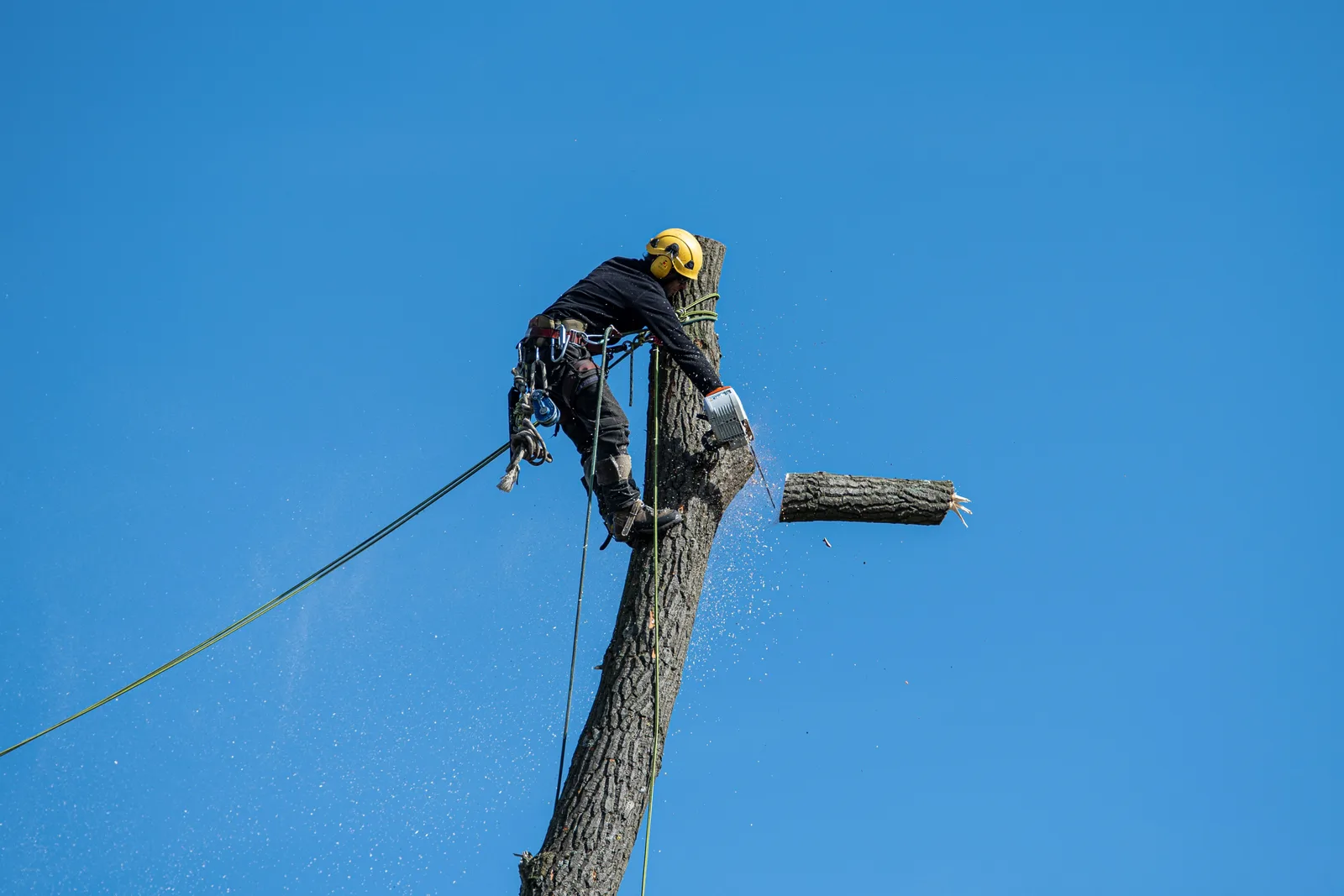
An arborist assesses the tree and writes the prescription. A climber works it from the spar. An aerial-lift operator works it from the bucket.
Ground workers feed the chipper, move brush and control the drop zone. A plant-health technician applies treatment under a licence the state issues.
An estimator prices the job, and a crew leader runs it on site.
Write one line per role: what they may do alone, what they may do only under a certified arborist, and what they may not do at all. Here is a template you can copy.
- Role
- climber.
- May do alone
- prune live limbs from the spar, up to the size named in the job prescription.
- May do only under a certified arborist
- rig and lower limbs, work near a service drop.
- May never do
- work alone on a removal, operate the stump grinder, or act as the sole ground spotter.
- Sign-off
- certified arborist name, date, and the tasks observed.
Equipment authority is part of the same line. A ground worker who has run a chipper for three years is not automatically cleared for a stump grinder or a bucket truck.
The tree service equipment and setup guide covers what each machine demands of its operator, which is the standard you are writing against.
Role Scorecard Elements
- Safe scope
- Project duties
- Equipment authority
- Customer communication
- Documentation
- Quality checks
- Decisions and escalation
Keep the scope short enough that a new hire can repeat it back on day one. If it runs past a page, nobody reads it and the crew falls back on habit.
Decision two: what the role costs
Do not price a climber against a national wage table and call it done. Price the role against what the crew produces in an hour and what the truck costs while it sits.
The arithmetic is yours to fill in. Revenue per crew hour is the starting point. Subtract crew wages, workers compensation premiums, fuel, chipper and truck maintenance, disposal fees and equipment depreciation. What is left has to cover the days the crew does not work: rain, ice, breakdowns and the weeks between storm calls.
In Canada, the workers compensation equivalent is WSIB in Ontario, WorkSafeBC in British Columbia or Alberta WCB.
Work one example with typical figures. A crew bills $175 per crew hour and logs 1,200 billable hours a year. Revenue is $210,000.
If the truck and chipper cost $45,000 a year to own and run, the truck needs about 257 billable hours at that rate to cover its own cost. Replace these with your own numbers before you set a wage.
That number, not the wage table, tells you what you can pay a climber and still make money on a removal.
The tree service pricing and profit guide works the same arithmetic from the quote side. Read it before you set a wage, because a rate you cannot recover in the quote is a rate you will cut in three months.
Check current local figures against the BLS wage estimates for tree trimmers and pruners and against your own postings. The BLS page describes the work and publishes wage estimates by industry and region. It is a starting point, not a decision.
Decision three: how you prove competence
An interview tells you how someone talks about a removal. A field observation tells you whether they rig one.
Run both, and score them the same way for every candidate. Ask the same job-related questions about safety, craft, judgment, equipment, customer conduct and reliability. Then watch the person work, on a real job, with a named observer and a written sheet.
Prove competence against a published standard. The International Society of Arboriculture (ISA) certifies arborists, and the Tree Care Industry Association (TCIA) publishes safety and training programs, including the Certified Treecare Safety Professional credential. Sign your field sheet against the task list in the standard you train to.
The how to hire reliable staff guide covers the interview side in detail. The field side is yours to build.
Stage the onboarding so each step has something to sign against:
- Company rules, hazard reporting and who to call.
- Equipment walkaround and the limits of each machine.
- Observation only, on a pruning job, with no production role.
- Supervised taskschipper feeding, brush drag, drop-zone control.
- Customer conduct and site closeout, including cleanup and disposal.
- Documented authorization for named tasks, signed by the certified arborist who observed them.
The tree service quality assurance checklist supplies the sign-off format. Use it rather than inventing a new sheet, so the records sit in one place.
A sign-off sheet that works records the date, the task observed, ground conditions, the observer name and signature, and the expiry date.
A worker who has not signed stage six does not run a job alone, however many years they claim.
Decision four: when to stop hiring
Hiring is not always the fix. Sometimes the schedule is the problem.
Watch overtime, missed breaks, rework and callbacks together. If overtime is climbing while quote-to-close rate holds steady, you are underpricing the work, not understaffed. If callbacks cluster on one crew, the gap is training, not headcount.
Track four numbers monthly and act on the one that moves:
| Metric | What it tells you |
|---|---|
| Revenue per crew hour | Whether the crew is producing enough to carry a new wage |
| Break-even per truck | How many billable hours the truck needs before it earns |
| Quote-to-close rate | Whether your pricing is landing or scaring work away |
| Referral share | Whether the quality holds up after the truck leaves |
A second crew changes all four. Run the numbers for one crew until they are stable before you split the work.
Storm season and the hiring gap
Storm response compresses hiring into days. Ice takes down a limb on a service drop, the phone does not stop, and every crew in the region is booked.
You cannot vet a climber in that window. What you can do is keep a short list of people you have already observed, already signed off, and already know will answer the phone.
Two things make that list work. First, keep the sign-off current, so a person who has not worked for you in a year is not treated as cleared.
Second, decide in advance what you will turn down. A removal you cannot staff safely is a job you decline, and saying so early protects the customer relationship better than a crew that arrives exhausted.
Cash flow is the other half. Storm work pays late, insurance claims take longer, and wages land first. Keep enough working capital to cover one payroll cycle before the storm arrives, and check your own numbers rather than a rule of thumb.
Where the rules come from in the United States
Four sources draw the lines, and none of them is a substitute for your own state.
OSHA's tree care standards page connects arboricultural work to general-industry requirements.
These cover records, walking and working surfaces, aerial lifts, and protective equipment.
They also cover first aid, electrical work, and hazardous substances. It is a useful map of what a safety program has to address.
The Department of Labor small business compliance page sets out duties for new employers. These duties cover:
- wage
- overtime
- timekeeping
- child labor
- leave
- notice
- recordkeeping
The EEOC small business resource center covers nondiscrimination, accommodations, employment records, workplace notices and fair hiring decisions.
In Canada, the second market for this site, the equivalents are your provincial labour ministry, WSIB in Ontario, WorkSafeBC in British Columbia and Alberta WCB. Hiring a worker from outside the country runs through the Temporary Foreign Worker Program, and eligibility for a specific worker is a question for immigration counsel, not for this page.
Private-tree rules in the United States are set by city or county ordinance, and each has its own permit process. Confirm with the local tree ordinance office before the crew leaves the yard. In Canada, Toronto, Vancouver and Montreal set their own bylaws and permits.
Common questions
Who should own hiring and training?
The owner sets the wage and the scope. Daily ownership belongs with whoever runs the crew, because that person sees the field work that proves competence. Keep the sign-off records with one named person so nothing is signed twice or missed.
How often should the scope be reviewed?
Review each role's scope when equipment changes, when a new service is added, or after any incident or serious near miss. Otherwise once a year is enough. Write the review date on the scope so the crew knows which version is current.
Which numbers matter most?
Revenue per crew hour and break-even per truck decide what you can pay. Quote-to-close rate and referral share tell you whether the quality holds. Pick the smallest set that changes an action, and write the formula and its source before you compare two months.
What should a new owner avoid?
Do not copy another company's wage, crew size or equipment list without knowing its customer mix and its ticket size. Do not treat a national average as a local rate. And do not send a new worker into high-risk production because the schedule is tight; that is the decision that ends businesses.