Guides
Tree service equipment: the case for used, the case for new
New and used tree service equipment split on duty cycles, financing, resale value and chipper uptime, not on brand loyalty or dealer pressure.
What to take away
- Buy used where parts are common and inspection is simplea 12-inch disc chipper, a tow-behind stump grinder, a mini skid steer.
- Buy new where the asset is a rating or a fixed service liferopes, harnesses, lanyards, pro chainsaws, aerial devices.
- Typical used prices as of 2026chipper $25,000 to $45,000, grinder $12,000 to $25,000, 40-foot bucket truck $35,000 to $75,000, pro saw $350 to $500.
- Duty cycle decides more than price. A machine run 400 hours a year carries a used purchase. One run 1,500 hours a year carries a payment.
- Compare financing cost, resale and downtime, not sticker price. Section 179 or dealer terms can close much of the gap.
What actually differs between new and used
New equipment buys certainty: a warranty, a known service history, dealer support and manufacturer financing.
Used equipment buys capacity per dollar. The same capital gets more reach, more horsepower or a second truck.
The trade is downtime risk against a monthly payment. Cost of capital and repair exposure settle the choice, not brand loyalty.
Start with the duty cycle. A crew running one chipper five days a week faces a different question than a crew running two crews and a grinder seasonally. The tree service equipment and setup guide explains how each machine fits a fleet and which ones can wait.
Bucket trucks, where used is a gamble
A used bucket truck is a boom, a turret and a dielectric rating. All three degrade, and Altec and Terex units fill most of the used market.
Boom trucks change how insurers read your business. Insurance for a tree service business covers what underwriters ask about aerial devices.
OSHA's tree care overview lists the services the industry covers, from pruning and removal to line clearance.
Line clearance work adds minimum approach distances and training duties that OSHA 1910.269 sets for arborists near energized lines. State plans can add their own rules.
Have a certified aerial device mechanic inspect the boom, rotation bearing and dielectric test. Without a recent test, price the truck as a chassis and a bed.
Prices for chippers, grinders, trucks and saws
| Machine | Typical used price, 2026 | Typical new price, 2026 | What drives the spread |
|---|---|---|---|
| 12-inch disc chipper (Bandit 12XP, Vermeer BC1000XL) | $25,000 to $45,000 | $55,000 to $85,000 | Engine, winch, hours, service records |
| Tow-behind stump grinder (Rayco RG37, Bandit 2550) | $12,000 to $25,000 | $30,000 to $50,000 | Cutting width, engine, teeth, bearings |
| 40-foot bucket truck (Altec AT40-G, Terex Hi-Ranger) | $35,000 to $75,000 | $150,000 to $220,000 | Dielectric test date, boom hours, chassis miles |
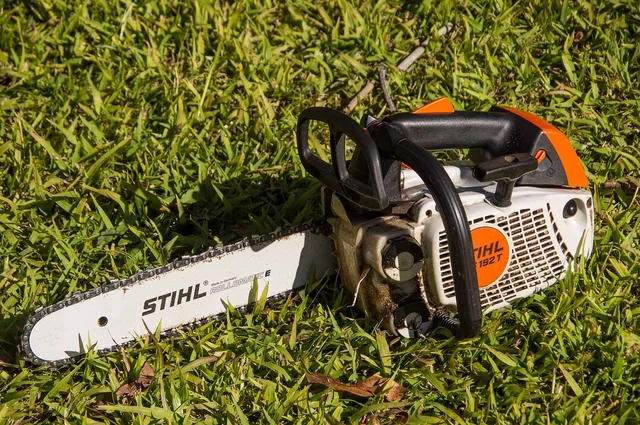
| Pro chainsaw (Stihl MS 261, Husqvarna 550 XP) | $350 to $500 | $600 to $700 | Compression, hours, bar and chain |
| Mini skid steer (Ditch Witch SK800, Vermeer S800TX) | $18,000 to $35,000 | $40,000 to $70,000 | Tracks, hours, attachment package |
Figures are typical asking prices, not quotes.
Used Bandit and Vermeer chippers keep parts availability well past ten years. A 12-inch unit with 1,800 hours, run 400 hours a year, still has years of work left.
Inspect the feed rollers, clutch, anvil gap and engine hours against the hour meter record. A worn anvil is a repair bill, not a bargain.
Used Rayco RG37 and Bandit 2550 grinders cut stumps to about 24 inches. Teeth and cutter wheel bearings decide whether the unit is cheap or expensive.
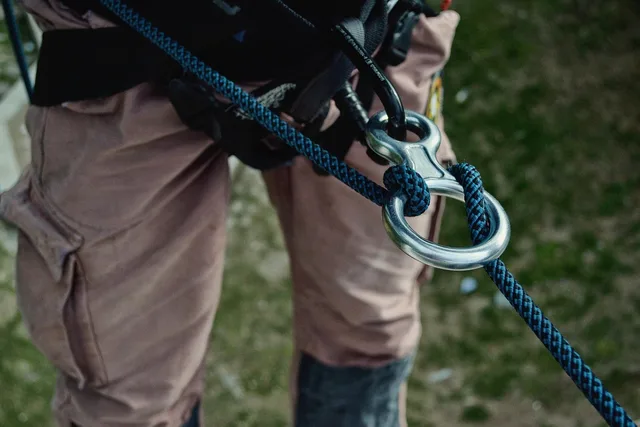
Ropes, harnesses, lanyards and friction devices carry fixed service lives. Blocks and port-a-wraps are the narrow exception, and the manufacturer's manual governs retirement.
Where each option fits
Fits a tree service when
- New 12-inch chipper (Bandit 12XP, Vermeer BC1000XL)
- It runs most days and downtime costs more than the payment
- Used chipper or grinder (Bandit 12XP, Rayco RG37)
- Inspection is simple, parts are common, duty cycle is moderate
- Lease or finance a new unit
- You need capacity now and want payments to match the season
- Short-term rental of a chipper or lift
- Demand spikes for a few weeks after a storm
- Subcontract removals to another tree service
- A nearby operator already owns the capacity
Trade-off
- New 12-inch chipper (Bandit 12XP, Vermeer BC1000XL)
- Capital committed before the first job
- Used chipper or grinder (Bandit 12XP, Rayco RG37)
- Repairs land in your busiest weeks
- Lease or finance a new unit
- Total cost exceeds buying over the term
- Short-term rental of a chipper or lift
- Availability fails on the days you need it most
- Subcontract removals to another tree service
- Your margin and the customer go with it
Every row moves cost between capital and margin. Rental covers a storm week, not a season, and the machine you want is often already booked. Tree service pricing that protects margin shows where each choice lands on the job.
Example: the arithmetic before you commit
Run these steps on your own figures.
- Add the landed costpurchase price, import duty and state sales tax on a cross-border machine. Canadian buyers add provincial sales tax and brokerage.
- Add financing cost over the term, at the rate you are actually offered.
- Add annual maintenance and wear parts from service records, not a verbal history.
- Multiply downtime days by your revenue per crew hour.
- Subtract resale value at the year you expect to sell.
Downtime rarely lands in a quiet month. A machine that saves $20,000 today and loses eight days in June can cost more than the new one.
The Bureau of Labor Statistics wage estimates for tree trimmers and pruners give area wages you can use to set a crew hour value.
Serial numbers, inspection dates, repair invoices and warranty papers belong with each unit. The tree service equipment checklist for new owners lists what to log from the first week and when to review it.
Common questions
Is a used chipper a safe buy?
Often yes, when the service history is documented and a mechanic checks the feed rollers, clutch, anvil and engine hours. The risk is a machine whose wear items are already spent.
Should I ever buy a used bucket truck?
Only with a current dielectric test and an inspection by a certified aerial device mechanic. Without that paperwork, price it as a chassis and a bed.
Does buying used actually save money?
It saves capital, not necessarily cost. A machine that fails in June can cost more than the new one.
What should I record from the first week?
Serial numbers, assigned operators, purchase dates, condition notes and warranties for every valuable tool.