Guides
Tree Service Business Operations: Storm Documentation
Tree service business operations for storms: document damage, manage claims and billing, set crew controls, and handle municipal contracts.
What to take away
- Tree service business operations in Atlantic Canada include storm cleanup that may involve an insurance claim, but the homeowner usually pays unless the insurer issues a direction to pay.
- Photograph damage, record the peril and keep scope notes before the first cut; clear records help the adjuster assess the work.
- Ice storm cleanup Atlantic Canada crews face salt, wind and frozen ground; hurricane tree damage claims follow the same paperwork with a different hazard profile.
- Report every injury and near miss to the applicable provincial workers' compensation authority, and investigate serious incidents promptly.
- Use an agreed scope and itemized invoice, and confirm payment terms before mobilizing.
How Atlantic Canada storm work differs from routine pruning
Routine pruning is scheduled, priced from a quote and paid by the property owner. Storm work arrives without warning, often at night, and the payer is frequently an insurer. That changes everything downstream.
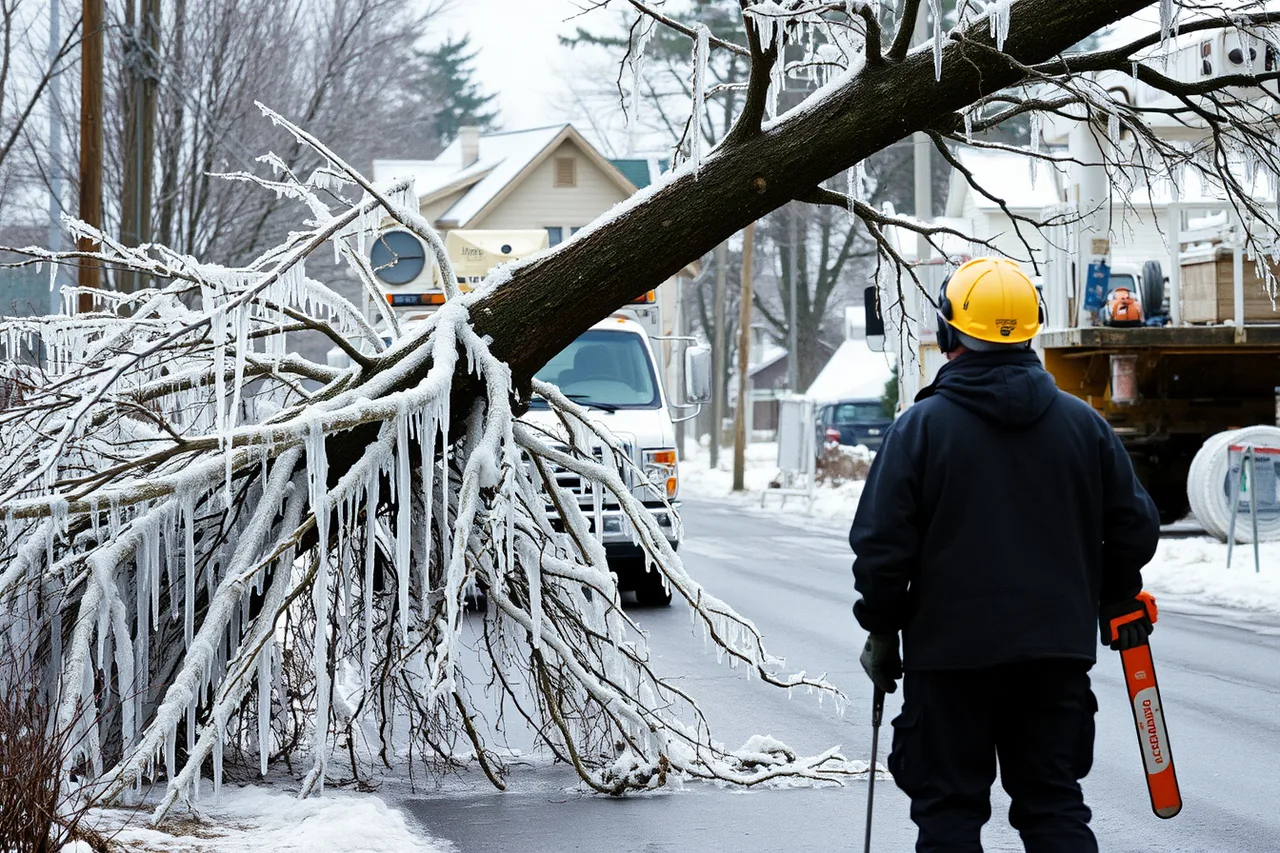
Atlantic Canada gets both ice and wind. Freezing rain loads branches until they fail; hurricanes and post-tropical storms strip crowns and drop whole stems. Nova Scotia, New Brunswick, Prince Edward Island and Newfoundland and Labrador each see a different mix, but the paperwork is similar.
Access is the first constraint. Ice storm cleanup Atlantic Canada jobs often involve blocked lanes, downed conductors and trees leaning on structures. You cannot start until the utility clears the line, and that wait belongs in your scope notes.
Volume is the second constraint. A single storm can generate more calls in a week than a normal month. Crews that triage by risk, hazard first, then habitability, then cosmetic, finish more billable work than crews that answer the phone in order.
Municipal tree-protection requirements vary across Atlantic Canada. In Halifax Regional Municipality, as elsewhere, contact the municipality's tree-permit office or bylaw officer before cutting a potentially protected tree; document any immediate hazard and ask what emergency procedure applies.
If you take on crane-assisted removals or work near energized lines, confirm your coverage before you bid. The insurance costs and coverage page offers additional background, but verify your own policy terms.
Documenting ice storm and hurricane damage for an insurance claim
The adjuster was not there. Your file is the evidence. Build it before the saw starts, because the stump and the debris are gone by the time anyone reviews the claim.
Work through these steps on every storm file:
- Photograph the tree in context, then the failure point, then the target it threatens. Wide, medium, close.
- Record the perilice accumulation, wind, fallen conductor, or a combination. Note the date and time of the loss if the owner knows it.
- Note the address, the legal description if you have it, and the claim number the owner received from their insurer.
- Sketch the work area and mark the drop zone, the access route and any protected trees.
- Write a scope note that a claims clerk can read without calling you: what comes down, what can be pruned, what stays.
- Photograph the completed work from the same angles, plus the cleared site.
- Keep the file under your record-retention policy, preserve it if a dispute is foreseeable, and ask the insurer or legal counsel about any applicable limitation period.
Hurricane tree damage claims add one item: a wind event can damage trees that show no obvious failure. Note lean, root plate movement and cracked unions, because this information can help the insurer assess the claim. Whether removal is covered depends on the policy and claim assessment.
Ice is different again. Ice-loaded limbs fail in compression and shear, and the wound is often hidden under snow. Photograph the crown before you remove anything, since the failure pattern supports the cause of loss.
The province of British Columbia organizes storm response through its own emergency framework, and its Public safety and emergency services pages show how a provincial response is structured. That is useful when a client owns property in more than one province.
If a homeowner disputes your scope or your invoice, treat it as a service issue rather than a collections issue first. A written complaint handling process keeps the insurer's file clean and protects your reputation in a small market.
Billing storm work with photos and scope notes
Clear documentation supports a storm-work invoice; vague invoices can be harder to review. The difference is usually the scope note, not the rate.
Hourly pricing suits emergency stabilization, where nobody knows how long the tree will take. Unit pricing suits debris removal and chipping, where volume is predictable. Many storm invoices combine both; agree on the scope and applicable rates before work begins.
Billing insurers
| Billing method | Use it for | What the insurer wants to see |
|---|---|---|
| Hourly, per crew | Emergency stabilization, hazard abatement | Crew size, start and stop times, task log |
| Hourly, per equipment | Crane, bucket truck, chipper | Equipment hours, operator, job reference |
| Unit rate, per cubic yard | Debris hauling and disposal | Load count, disposal site, tipping receipts |
| Unit rate, per tree | Straightforward removals | Tree count, diameter, access notes |
| Fixed price, per site | Municipal cleanup blocks | Scope map, completion photos, sign-off |
An example of scope documentation, not a rate quote: A Halifax homeowner has a spruce leaning over a garage after a post-tropical storm. You photograph the lean and the root plate, note the conductor contact and wait for the utility. Two crew members stabilize for three hours, a bucket truck removes the stem, and the debris fills four cubic yards.
The invoice records the stabilization hours, the equipment hours, the agreed unit rate for disposal and the disposal receipt. The scope note explains why the tree could not be pruned instead, giving the insurer a clear basis to review the charges rather than a single line reading "storm cleanup."
Send the invoice to the owner unless the insurer has issued a direction to pay. Ask for the claim number and adjuster name at the first call, and put both on every page.
Track what each storm file costs you to produce and what it collects. Storm work can look profitable on the invoice and lose money on the admin; use the markets for tree service as background when planning service areas, but evaluate storm files on their own costs and collections.
Salt-laden coastal wind work and crew safety in Halifax and St. John's
Halifax tree service work and St. John's tree service work share a hazard that inland crews rarely meet: salt. Coastal wind carries salt spray onto foliage, equipment and skin, and it accelerates corrosion on chains, cables and hydraulic fittings.

Rinse saws, ropes and hardware with fresh water at the end of every coastal shift. Salt left on a climbing line degrades the sheath, and a line that fails in a coastal wind is a line that should have been retired.
Wind is the second hazard. Coastal wind tree work in Halifax and St. John's often continues after the storm has passed, when gusts remain unpredictable. Set a stop-work limit for climbing and crane picks based on equipment guidance, site conditions and your safety procedures, and give one person the authority to call a stop.
Frozen ground is the third. Ice storm cleanup Atlantic Canada crews work on slopes that are hard in the morning and greasy by noon. Use traction aids, assign a spotter on slopes, and stop work when footing is unsafe.
St. John's adds fog and rapid weather changes. Halifax adds freeze-thaw cycles and a large urban canopy close to overhead lines. Both cities have narrow streets where the drop zone is a sidewalk, so traffic control is part of the job, not an extra.
Fit crews with cut-resistant leg protection, helmets with chin straps and eye protection rated for flying debris. The CSA Z133 safety standard for arboricultural operations is the baseline, alongside the applicable provincial occupational health and safety requirements: Nova Scotia's Occupational Health and Safety Act, New Brunswick's Occupational Health and Safety Act, Prince Edward Island's Occupational Health and Safety Act, or Newfoundland and Labrador's Occupational Health and Safety Act.
Rotate crews. Storm response runs long days, and fatigue causes more chainsaw injuries than any single hazard on the site. A tired climber on a salt-slicked spar is the risk you can actually control.
Reporting injuries and incidents during storm response
Report workplace injuries immediately to the applicable provincial workers' compensation authority. In Atlantic Canada, these are the Workers' Compensation Board of Nova Scotia (WCB Nova Scotia), WorkSafeNB, the Workers Compensation Board of Prince Edward Island (WCB PEI), and WorkplaceNL. Reporting requirements and deadlines vary by province and incident, so contact the applicable authority and follow its current instructions.
Report the injury, then investigate. WorkSafeBC applies in British Columbia, not Atlantic Canada; use the reporting instructions from the applicable provincial authority listed above.
For a serious incident, follow the applicable provincial occupational health and safety requirements and regulator's instructions. WorkSafeBC's conducting an employer investigation page is specific to British Columbia; its general topics include the sequence of events, contributing causes and corrective action, but it does not replace Atlantic Canada's rules.
Keep the investigation factual. Storm files attract scrutiny, and an investigation that blames the weather and stops there will not satisfy a regulator or an insurer.
Near misses matter too. A limb that grazes a climber is a free lesson. Log it, review it at the next tailgate meeting and change the plan if the plan was wrong.
If you use subcontractors on storm jobs, confirm their coverage before they start and obtain a workers' compensation clearance letter from the applicable board. The letter confirms their account is in good standing and helps limit your exposure if they are injured on your job.
Getting paid: deposits, retainers and municipal cleanup contracts
Storm work is cash-hungry. Payroll, fuel, equipment and disposal all land before the insurer pays, and insurers are not fast.
Ask for a deposit on private storm work where the owner is the payer. Where the insurer has issued a direction to pay, ask for a retainer against the deductible and any betterment.
Municipal cleanup contracts are the largest and slowest files. They usually come through a standing offer or a request for proposals, with a unit-price schedule and a completion deadline. Read the payment terms before you bid.
Hold-back clauses are common on municipal work. Price them into your rate rather than discovering them at the end of the season.
Keep a storm reserve. One month of payroll in the bank turns a slow-paying contract from a crisis into an inconvenience.
Measure the storm season like any other part of the business. The KPIs owners should track monthly can help you assess whether storm work is paying for the equipment it consumes.
Storm work also brings new customers who found you in an emergency. Follow up after the cleanup, because a household that trusts you with a fallen tree may call again; these service practices can help you win more tree service customers without buying a single ad.